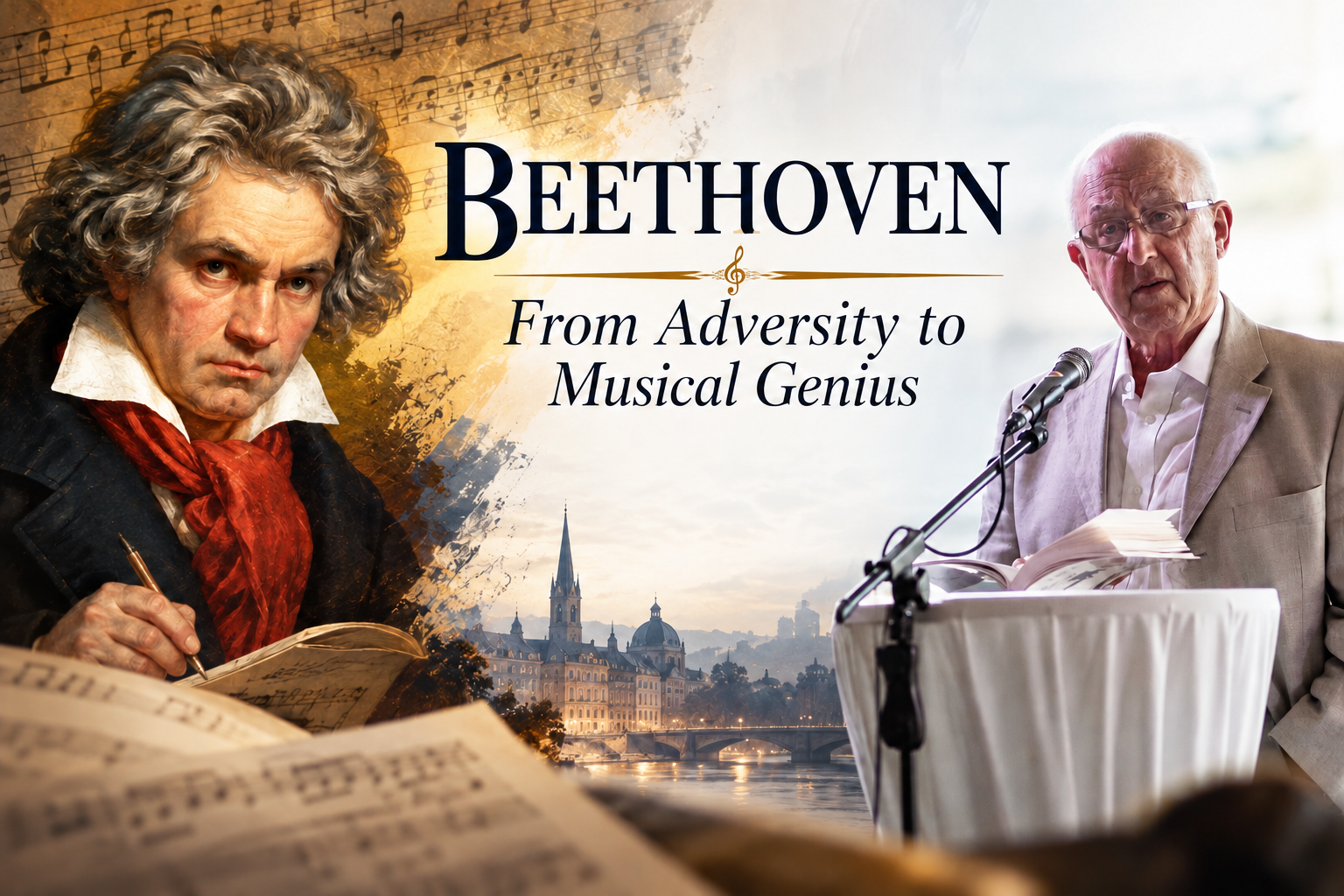
LUDWIG van BEETHOVEN
- The Early Days (1770-1798)
There is an old joke about a billionaire industrialist who was interviewed on a chat show. When asked about his early life, he said that he had never learned to read and write. He had started collecting scrap at the age of ten and made his first million at seventeen. The interviewer shook his head in admiration and said, “Just think, you’ve made billions without being able to read and write. I wonder what extraordinary achievements you would have made, given that advantage.” The billionaire replied, “I’d have become a bus conductor.”
For some extraordinary reason that story always reminds me of Beethoven. The comparison is not, strictly speaking, a fair one, because Beethoven was born into a musical world and showed signs of his genius at a very early age: but, if ever a man overcame hardship, adversity, and lack of formal education to achieve astonishing success, it was he.
I intend, in a series of presentations, to illustrate Beethoven’s individuality as a composer as well as his genius, but in this introduction, the music we shall hear has been chosen to illustrate the sounds he would have heard as a child and his progression from boy prodigy to virtuoso pianist/composer.
* * *
Ludwig, or Louis, van Beethoven as he often referred himself in his correspondence, was born at Bonn, on the river Rhine south of Cologne, on 16th December 1770, to Maria, the wife of Johann, a tenor in the choir of the chapel of the Elector of Cologne. That sounds quite elegant, but really it was anything but. Maria was the daughter of the chief cook at a neighbouring court, and although only 23 years old, was already the widow of a court valet. Johann’s father, the composer’s grandfather, was also named Ludwig. He was the Kapellmeister (Director of music) at the Bonn court. Louis Beethoven, as a boy, was surrounded by the music played by those court musicians, invariably the strongly repetitive rhythms of the baroque style. Let us first hear a German baroque example that he would have known.
(Track 1: Georg Philipp Telemann, Viola Concerto in G major. 2nd mvt.[from 3”45 -6”30 –<3min.])
As Kapellmeister, Grandfather Ludwig was a man of standing. He considered that his son had married beneath him. In truth, there was little social distinction between the musicians and the other servants at the noble courts of that time. Old Ludwig, however, did recognise Maria as a good person and Johann’s wife. Significantly, young Ludwig always recalled his grandfather with great affection, although the old man died when the boy was barely 3 years old. Indeed, when, some 20 years later, the young composer finally left Bonn for Vienna, the only notable memento he took with him was a painting of his grandfather, Ludwig senior. It stayed with him throughout his life.
Beethoven also deeply loved his mother. Maria was a gentle, pious woman, respected by all who knew her. Evidently, she was not one of the world’s best housekeepers, but how far those reports were due to her misfortune in being married to Johann van Beethoven is not recorded. Johann was a tenor chorister, but he was also a drunkard and a bully. The docile Maria bore him seven children, four of whom died in infancy.
Ludwig and his younger brothers Carl Kasper and Nikolaus Johann were the three children who survived infancy. They were all highly intelligent, but they were kept in squalid, penurious circumstances by their father’s despotic nature, and his addiction to alcohol. The effect of this domestic situation on Maria and on all the children can well be imagined.
Ludwig, in particular, suffered. He was the eldest child, and the most gifted. His remarkable talent was obvious from the earliest age. He was also of a hyper-sensitive and violently passionate nature, deeply troubled by his father’s foul character, but always conscious of his responsibilities as the first born. Throughout his life, he remained ultra protective of his younger brothers.
The extraordinary musical talents of the eldest Beethoven child were so apparent that, from the age of four, he was compelled by his father to study the keyboard almost incessantly. When just seven years old, Ludwig was pressed into a court concert. Johann’s only interest was to use his son’s musical abilities to bring money into the home, so that he could drink it away.
Unfortunately, all other education was sacrificed. At the age of ten, the boy was forced into an apprenticeship to the court organist and composer, Christian Gottlob Neefe, instead of becoming a student at the gymnasium (grammar school), where he would have received a good all round education. Neefe, however, was a good man, a good teacher and a fine musician. He quickly recognised Ludwig’s potential and introduced the boy to the works of Johann Sebastian Bach.
Track 2. Prelude and fugue No.1 from The Well-Tempered Clavier Bk.1 by J.S. Bach. Sviatoslav Richter piano (4.33min).
* * *
In 1784, at just thirteen, the boy Ludwig became Neefe’s official assistant as court organist in Bonn, at the court of the Elector, Max Franz, the brother of Marie Antoinette. There, the youngster met members of the aristocracy. He was accepted and befriended by, among others, the distinguished von Breuning family, and by the influential diplomat, Count Waldstein.
It was probably Waldstein who arranged, in 1787, for Ludwig, at sixteen, to go to Vienna. It was hoped he would take lessons from Mozart. Indeed, he did meet Mozart and played for him. It is possible that he even studied with him very briefly, but he had been in Vienna only a couple of weeks when he heard that his mother was dying. He left the Austrian capital at once to return to Bonn to be with her and his brothers.
He found his mother in a poor state, and she died just two months later. After the tragedy of her loss, the situation at home deteriorated even further. Within a couple of years, Johann, Ludwig’s father, the drunken widower, was dismissed from his post in the court choir. Now, at eighteen years of age, Louis was compelled to accept total responsibility for the care of himself and his two brothers.
His trivial earnings at the court were in no way sufficient to meet his needs, so he worked for most of his free hours, giving private lessons or playing viola in the orchestra of the opera. Although already an outstanding pianist, he was proficient with all string instruments. Thus, working twelve or fourteen hours every day, the boy prodigy came to manhood.
Track 3. That was, of course, Mozart, the andante from his Piano Concerto No.21 in C Major, K.467, the famous ‘Elvira Madigan’ music. It was played here by Alfred Brendel. Composed in 1785, when Louis was 14, this, and the Bach played earlier, was the sort of music that Beethoven heard as a teen-ager and that greatly influenced his developing composing style. (6.30min).
* * *
People often talk of Beethoven’s three periods, but I believe that Beethoven’s life breaks more accurately into four periods. This first period ended two years later, with the death of his father in 1792. With both parents gone, the twenty-one year old Ludwig, once more with the help of his patrons, took himself and his brothers to Vienna, this time permanently. Once there, he ensured that his brothers were settled into careers: Carl as a music teacher and Johann an apothecary’s assistant.
Sadly, Beethoven’s hopes of studying with Mozart had been dashed. Mozart had died the previous December, aged just thirty-five. Fortuitously, though, the great Joseph Haydn returned to Vienna in 1795 and Ludwig was able to study with him, as well as with other leading members of the musical establishment of Vienna, including Salieri and Albrechtsberger. The relationships were not always easy: the young tyro’s progressive ideas, together with his prickly and hyper-sensitive nature, did not always meet with the approval of his mentors.
However, Beethoven soon became recognised as a virtuoso pianist and was welcomed into all the grand houses and palaces. The next ten-years, the years of his pianistic mastery in Vienna, formed his second period. Vienna was the capital of the Austro-Hungarian Empire and the centre of imperial and other noble patronage. Music was a vital daily source of entertainment for the nobility, and they willingly gave their patronage in return for the kudos of having the virtuoso perform in their homes, and perhaps dedicate new works to them.
Beethoven’s lightning brain made him a difficult person to deal with. He was often seen as impatient and temperamental. But it was the impatience and unpredictability of a genius. He was poorly educated by comparison with his patrons and at times appeared ill-mannered. He could be careless about his dress and general appearance, sometimes to the degree of scruffiness. But he was breathtakingly talented and super confident in his musicianship. Mozart had died at the end of 1791, but now, just a year or two later, Beethoven was the man to give the people what they wanted.
In March 1795, Ludwig van Beethoven gave his first public concert as a pianist. Even in the last decade of the eighteenth century, such events were most unusual. He played an early version of his own B-flat piano concerto. The concert was a tremendous success and Beethoven was critically acclaimed as a pianistic giant.
However, Ludwig, who never doubted his abilities as a pianist, was not satisfied with the composition. It would be another three years before that work was eventually published, as Concerto No.2, Op.19. Both concertos Nos.1 and 2 are strongly reminiscent of works of Mozart and Haydn, but neither lose anything of their individuality by the comparison.
Track 4. Piano Concerto No.2 in B flat, 3rd Mvt. Rondo, played by Glenn Gould with Leonard Bernstein & the Columbia Symphony Orchestra (5.30 min).
* * *
In the late seventeen-nineties, no grand musical evening in Vienna was complete without some show of individual brilliance from visiting or resident virtuosi. Competitions were held for the playing of impromptu improvisations upon simple or well-known themes. A well-established pianist and composer who considered himself a master of this art was Daniel Steibelt.
At the home of the Count Fries, after Beethoven, early in the evening, had introduced his Op. 11 trio (a work for piano, clarinet and cello), Steibelt performed a quintet of his own that was quite well received. He followed this by taking a simple theme from the Beethoven work and playing an improvisation upon it.
Beethoven’s fame as a virtuoso pianist was at this time reaching its zenith, and he, always quick to overreact, was thoroughly insulted. He walked slowly to the piano, picking up the music sheet for the cello part of the Steibelt quintet as he passed that stand. He placed the music upside down on the piano stand. He then drummed a one-finger theme out of the first few bars of the reversed bass clef and, irate and proud, began a long series of improvisations. Before he finished, Steibelt walked out of the room, so shamed that he never again allowed himself to be in the same building as Beethoven.
There is, of course no record of the music Beethoven created on that occasion; but, as an example of the inventive genius of the twenty-five year old composer, one can listen to the variations for piano and cello that he had published the previous year. The variations are on the extremely well-known original theme ‘See the conqu’ring hero comes’ from Handel’s oratorio Judas Maccabeus. The straightforward statement of the theme by the piano with the cello as accompanist is followed by a divertissement, a series of conversations between the two instruments covering as many musical moods as can be imagined. The young Beethoven displays all his arts in tongue-in-cheek pleasure, yet always with due reverence to his honoured and respected source.
Track 5. 12 Variations in G Major on “See the Conqu’ring Hero Comes”. Yo-Yo Mar and Emanuel Axe enjoy themselves (13.mins).
* * *
As I have already mentioned, Beethoven’s fame as a great virtuoso pianist was reaching its peak as the century came to an end. By the time he reached the age of twenty-seven, he had the nobility of Vienna fighting each other for his attendance at their evenings. His playing was fearless, bold, and uncompromising, yet at the same time capable of the most exquisite delicacy of touch and tenderness of expression. Incomparably brilliant, Ludwig van Beethoven was the brightest star in Vienna’s musical firmament.
When the first two piano concertos were finally published, to great acclaim in 1798, the composer declared dismissively that they were ‘not of his best work’. Yes, they illustrated what he had learned from Mozart and Haydn, but the grand mass of Beethoven creations, he knew, were still to come. As a composer, in terms of what he was destined to achieve, he had barely begun.
In the eight year period between January 1795 and December 1802, from the age of 24 until his 32nd birthday, Beethoven was to produce no less than one hundred and three significant new works, including the first three piano concertos, two symphonies, and no less than fifteen of his thirty-two piano sonatas. It was in this period that he began to move on from the musical world of Haydn and Mozart.
The Sonata No. 8, “Pathétique”, in 1798, was a pivotal work in this regard. By infusing classical forms with unprecedented emotional intensity and dramatic expression, it was a first step from the Classical era toward the Romantic era that would follow Beethoven. The work demonstrated early signs of the passionate, individual style that would become characteristic of the music of the nineteenth century. It helped establish Beethoven’s reputation as a visionary composer, quite apart from his pianistic skills. (Watch now a performance of the Pathétique sonata played by Daniel Barenboim).
(Track 6. Sonata No.8 in C Minor, Pathétique, Barenboim 20 mins.)
* * *
Finally, it must be remembered that although his success in Vienna put the misery of his childhood behind him, the scars left by that abuse would continue to torture him and to affect his relationships throughout his life. More of that, however, in the next part of the story of the life and music of Beethoven, when we enter the nineteenth century.
Thank you for your attention.
Tracks:
1.Telemann Viola Concerto in G major TWV 51:G9 (From 3min 45sec to 6min30).
- Bach Prelude and Fugue No.1 from The Well-tempered Clavier,<5 minutes)
- Mozart Piano Concerto No.21, K467 in C Major (2nd mvt.,<7 minutes)
- Beethoven Piano Concerto 2 in B flat, Op.19 (3rd mvt. <6mins.)
- 5. Beethoven Variations for piano and cello on Handel’s ‘Judas Maccabaeus’. (< 13min.)
- Beethoven Piano Sonata No. 8 in C Minor, Op.13 (Ist. mvt.,<10 min.; sonata, < 20min.)
Total music time = 45 minutes, or 55 with complete sonata.